
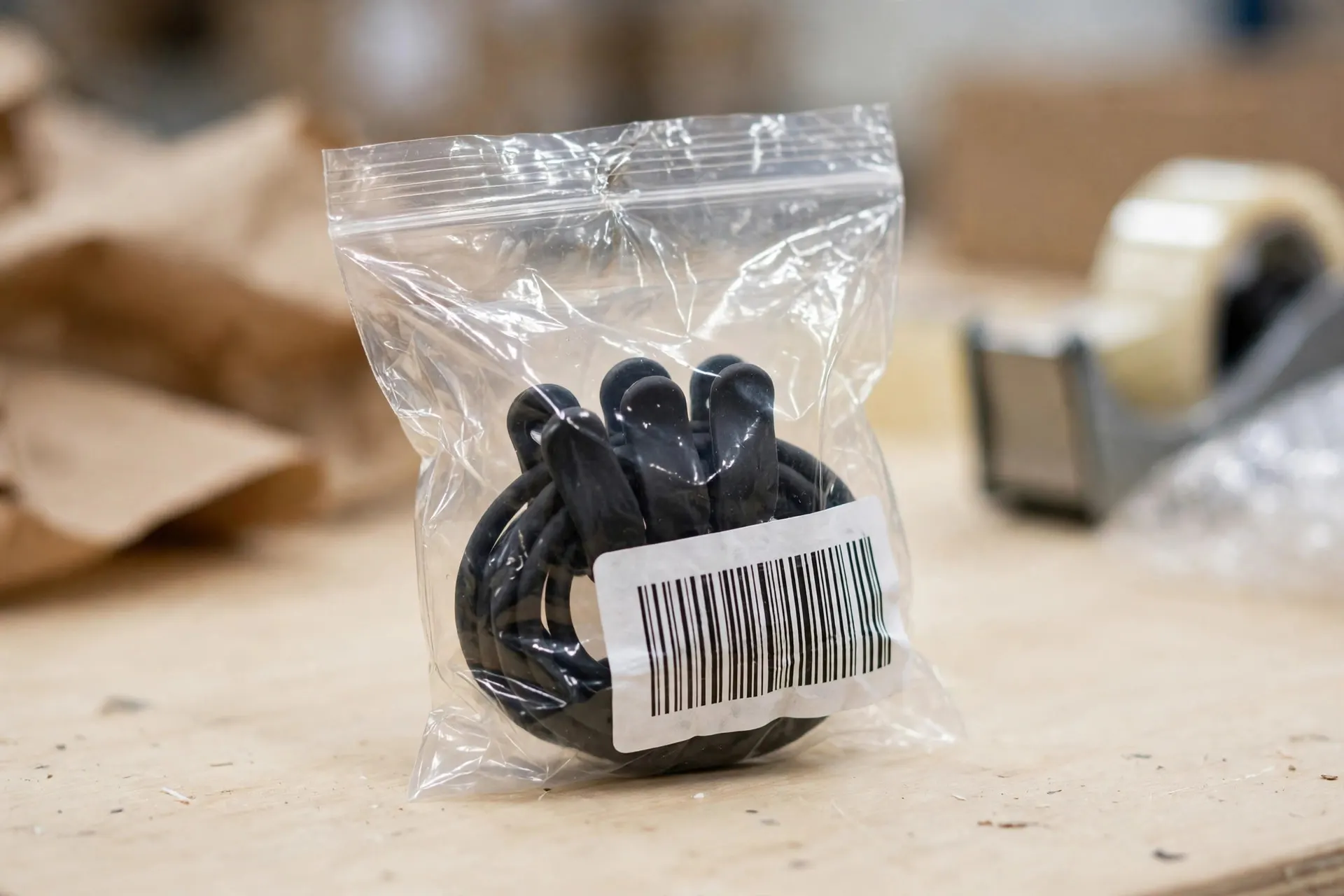
Amazon will not accept FBA stock that arrives unprepared. Every unit needs a scannable barcode, the right protective packaging, and a correctly labelled box, and since 2026 the responsibility for all of it sits with the seller. Amazon stopped offering prep and labelling services in its European stores, including the UK, on 1 July 2026, and it ended commingling on 31 March 2026. This guide explains the labelling and packaging rules as they stand for UK sellers, so your shipments check in cleanly instead of getting stuck in receiving.
Who needs an FNSKU label?
Every FBA unit needs a barcode Amazon can scan. There are two kinds: the manufacturer barcode (a UPC, EAN, JAN or ISBN printed on the product) and the Amazon barcode, known as an FNSKU label. Which one you must use depends on your role, not on whether the product already has a barcode.
Reseller, including authorised resellers and wholesale sellers: FNSKU label on every unit
Brand owner with the Brand Representative role, eligible product: Manufacturer barcode allowed, or FNSKU if you prefer
Product with no valid manufacturer barcode, or a GTIN exemption: FNSKU label, for everyone
Used, refurbished or other non-new condition: FNSKU label
A product can travel without an FNSKU label only if all four of these are true: it is in new condition, it has a single scannable UPC, EAN or ISBN that matches a single ASIN, it belongs to a brand in Amazon Brand Registry where you hold the Brand Representative role, and the product itself is registered to your brand. Multipacks and bundles often fail the single-barcode test, so they usually still need FNSKU labels. Being an authorised reseller is not enough: Amazon requires all resellers, including authorised ones, to use Amazon barcodes.
From 31 March 2026, Amazon treats reseller units that arrive without Amazon barcodes as defective. Amazon's UK fee table charges £0.15 per unit for a missing Amazon barcode, and that is the smallest cost of getting it wrong: problem stock can also delay the whole shipment.
FNSKU label specification
Amazon's specification for FNSKU labels is precise, because its fulfilment centres rely on high-speed scanners. The key requirements are:
Barcode type: Code 128, generated from Seller Central. The FNSKU itself is a 10-character identifier, usually starting with X00.
Size: Between 25.4 x 50.8 mm and 50.8 x 76.2 mm (roughly 1 x 2 inches). The minimum is 25.4 x 25.4 mm.
Print: Black ink on white, non-reflective labels with removable adhesive. Print with a thermal or laser printer at 300 dpi or more. Labels must stay readable and scannable for 24 months.
Quiet zone: At least 2.5 mm of blank space on all four sides of the barcode, with no text, graphics or borders inside it.
Placement: On a flat face, not a curve or a corner, at least 6 mm from the edge, and on the outside of any bag or wrap.
Other barcodes: Cover every other visible barcode on the unit, except serial number barcodes and Transparency codes. Never cover warnings, safety information or food information a label must show, such as ingredients, allergens and best-before date.
If a label cannot scan, the item will not be added to your inventory. Print at 100% scale, and check a sample label with a scanner before you print a full run.
Poly bags and suffocation warnings
Products that need protection in transit are often packed in poly bags, and Amazon's rules for them are strict. Poly bags must be transparent and sealed, at least 1.5 mil thick, and no more than 7.5 cm bigger than the product inside.
Any poly bag with an opening over 12 cm needs a suffocation warning printed on the bag. This is one of the most common reasons shipments are rejected, because sellers either forget the warning or print it too small. The warning must be in English and use Amazon's required wording. Check the current wording in Seller Central before you order bags, because the exact text matters.
The FNSKU label goes on the outside of the poly bag, never underneath it, so the barcode is visible without opening the bag.
Expiry dates
Expiry-dated products need the expiry date in DD-MM-YYYY or MM-YYYY format on the unit and on the outer box. Amazon also requires enough shelf life left on arrival for the stock to sell through, plus 90 days. Send stock that is close to expiry and Amazon may refuse it or mark it for disposal, so check dates before you book a shipment, not after it arrives.
Box labels and box rules
Every box in an FBA shipment needs its own unique FBA box ID label, printed 4 x 6 inches, and placed flat on the side of the carton, not the top or bottom. You also need to provide box content information for every box: the number of units of each SKU in the box, any expiry dates, and each box's weight and dimensions. You can give this through the web form in Seller Central, by uploading a file, with a 2D barcode on the box, or through the Selling Partner API. If you skip it, Amazon processes the boxes by hand and charges a manual processing fee of £0.15 per unit in the UK.
The box itself must meet Amazon's size and weight limits:
Minimum dimensions: Box of standard-size items: 15.2 x 10.0 x 2.5 cm. Box with one single oversize item: Same.
Maximum side length: Box of standard-size items: 63.5 cm on any side. Box with one single oversize item: May be exceeded where the item itself is longer, but the box must not be significantly longer than the item.
Weight: Box of standard-size items: 0.15 kg to 23 kg. Box with one single oversize item: May exceed 23 kg but not 30 kg.
Over the limit: Box of standard-size items: A box over 23 kg must be broken down into lighter boxes. Box with one single oversize item: A single item over 30 kg must be enrolled in the Heavy and Bulky programme.
Boxes must be rigid and six-sided with flaps intact. Amazon does not accept stretch wrap, straps, staples or packing peanuts on FBA boxes. Any box weighing more than 15 kg needs a "Team Lift" or "Heavy Package" label on the top and all four sides, five labels in total. Amazon does not provide these labels; you print them yourself, in the language of the destination country. Inaccurate weights or dimensions can lead to rejected shipments, extra fees, restricted shipping privileges or blocked future shipments, so weigh and measure every box rather than estimating.
Pallets
If you ship on pallets, Amazon accepts 1000 x 1200 mm or 800 x 1200 mm four-way wooden pallets, up to 1.8 m high and 500 kg, wrapped in clear film. Each pallet needs a pallet label, 4 x 6 inches, on all four sides, in the upper third of the pallet, for LTL (less-than-truckload) shipments.
Common mistakes that delay shipments
Most FBA receiving problems come from a small set of avoidable errors:
Sending reseller stock with only the manufacturer barcode, and no FNSKU label.
Printing FNSKU labels on an inkjet printer, at low resolution, or at less than 100% scale.
Placing the label on a curve, a corner, or underneath a poly bag.
Leaving a second visible barcode uncovered, so the scanner reads the wrong one.
Forgetting the suffocation warning on poly bags, or printing it too small.
Entering estimated box weights and dimensions in Seller Central instead of measured ones.
Skipping box content information and paying the manual processing fee on every unit.
Shipping boxes over 23 kg, or over 15 kg without the five heavy parcel labels.
Sending expiry-dated stock without enough shelf life left.
Work through the list before every shipment. A ten-minute check at packing time is cheaper than a shipment sitting in problem solve.
What happens if you get it wrong?
Amazon's consequences for unprepared stock are not theoretical. Units arriving without the required Amazon barcode are treated as defective and charged £0.15 per unit. Missing box content information brings a manual processing fee of £0.15 per unit. Overweight boxes, wrong quantities and missing labels can lead to refused inventory, disposal or return of stock, charges for preparation or non-compliance, and in repeated cases, blocked future shipments. Since Amazon stopped prepping and labelling in the UK, there is no fallback: whatever arrives is received as it is.
If labelling and packing is taking up time your business needs elsewhere, a prep centre can take it on. Our Amazon FBA preparation service covers FNSKU labelling, poly bagging, bubble wrap, bundling and box labelling, so stock arrives at Amazon ready to check in. That guide also explains what the service includes and how to choose a prep centre.
Frequently asked questions
Can I use the manufacturer barcode instead of an FNSKU label?
Only if you are the Brand Representative for a brand in Amazon Brand Registry, the product is new, it has a single scannable barcode matching a single ASIN, and the product is registered to your brand. Resellers must use FNSKU labels on every unit.
Does Amazon still label FBA stock for sellers?
No. Amazon stopped offering prep and labelling services for FBA shipments in its European stores, including the UK, on 1 July 2026. Every unit must arrive labelled and prepped.
What size should an FNSKU label be?
Between 25.4 x 50.8 mm and 50.8 x 76.2 mm, printed black on white at 300 dpi or more, with at least 2.5 mm of blank space around the barcode.
Do I need a suffocation warning on every poly bag?
Only on poly bags with an opening over 12 cm. The warning must be printed on the bag in English, using Amazon's required wording.
Related reading: Amazon FBA preparation services in the UK — https://storageandlogistic.com/blog/amazon-fba-prep-services-uk
A better fit for your business
Looking for better fulfilment pricing?
Answer four quick questions and request a quote tailored to your orders, products and delivery needs.