
When a customer clicks buy on your store, a chain of events starts in the warehouse. Within hours, sometimes minutes, that order has been picked from a shelf, packed into a parcel, checked, labelled and handed to a courier. This article follows one order through each step, so you can see what pick and pack really involves and where things can go wrong.
Step 1: The order arrives
Everything starts when the order reaches the warehouse system. For most brands, the store and the warehouse are connected, so an order placed on Shopify, Amazon, eBay or another channel appears in the warehouse system automatically, with no manual retyping. The order carries the customer's address, the items ordered, any special instructions, and the delivery service chosen.
At this point the system checks two things: that the items are in stock, and that the address is complete. If an item is out of stock, the order is held and the brand is told. If the address is incomplete, the order is flagged for a check rather than sent out to the wrong place. Catching these problems here is cheap; catching them after the parcel has left is not.
Step 2: Picking
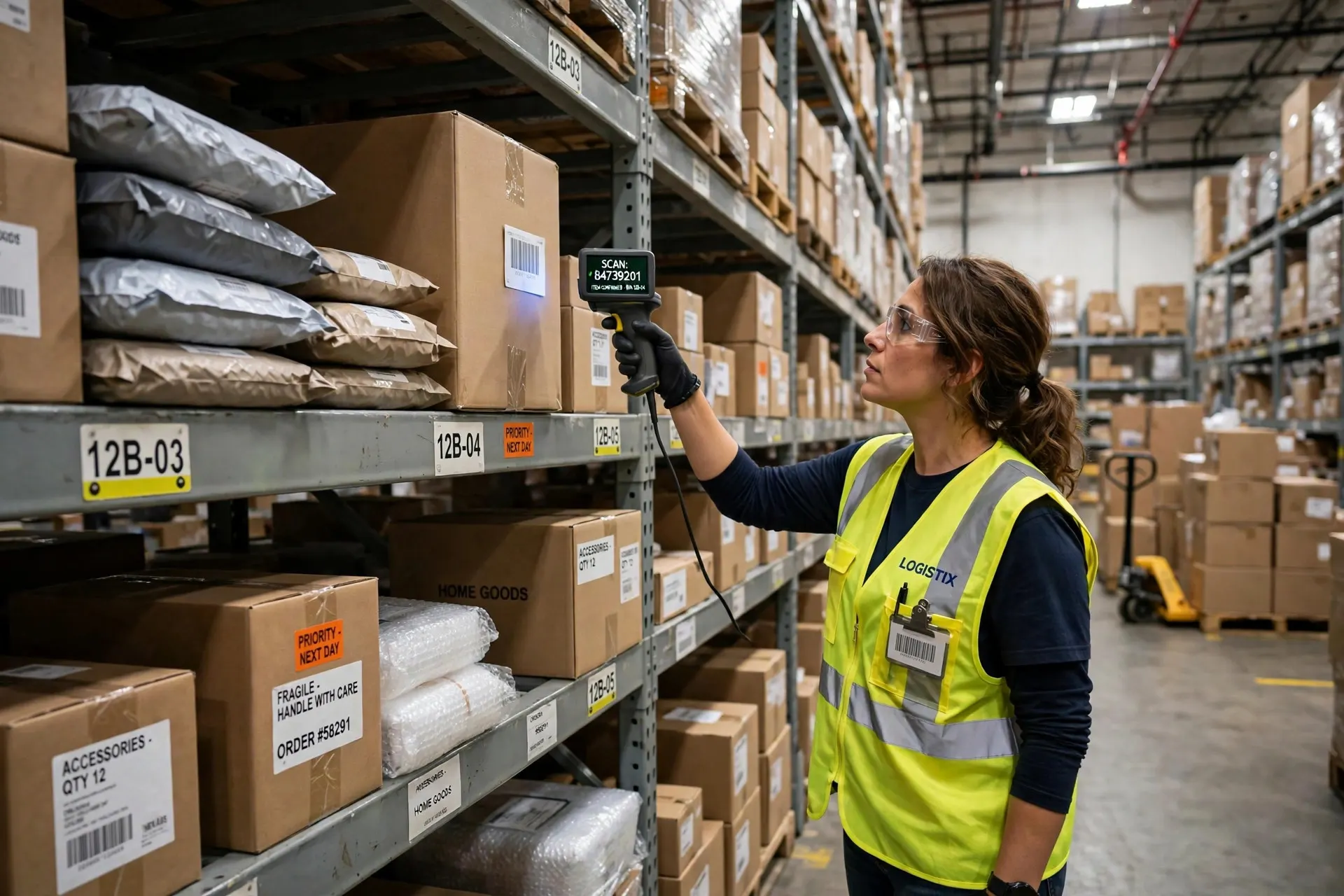
Picking is taking the ordered items off the shelf. The warehouse system turns the order into a pick list, which tells the picker exactly where each item is stored, by aisle, shelf and bin. In a well-run warehouse, products are stored so that the fastest-moving items are closest to the packing area, and every location is labelled.
The picker walks the route, takes the items, and scans each one. The scan is the accuracy check: the system knows what should have been picked, and it will flag a wrong scan immediately. This is why barcode scanning matters. A warehouse that picks by memory or by paper alone will make more mistakes than one where every pick is scanned and confirmed.
Picking is usually the part of the process where time is won or lost. A picker who walks a sensible route through a well-organised warehouse can pick many orders in an hour. A picker who hunts for stock in the wrong place, or finds an empty shelf where the system said stock was held, slows everything down. Accurate stock records are what make picking fast, and they are also what make it accurate.
Step 3: Packing
Once picked, the items go to a packing bench. The packer chooses the right box or mailer for the order: small enough to protect the contents without wasting space or adding unnecessary weight, large enough to fit everything safely. The items are packed with appropriate protection, such as void fill or bubble wrap where the products need it, and any inserts the brand has supplied, such as a thank-you card or a promotional leaflet.
Packing is where the customer's first impression of your brand is formed. A parcel that arrives with the right items, neatly packed and undamaged, tells the customer the brand cares. A parcel that arrives with the wrong item, or rattling around in a box three times too big, tells them the opposite. Good packing is not cosmetic; it is part of the product.
Step 4: The quality check
Before the parcel is sealed, it is checked. In most warehouses this means scanning the items again against the order, confirming the quantities are right, and checking the parcel is packed securely. Some providers check every order; others check a sample. Either way, the check exists to catch the errors that scanning at the pick stage missed.
This is the last point at which a mistake is cheap to fix. Opening a parcel on the bench and swapping an item takes a minute. Replacing a wrong order after the customer has received it takes a replacement parcel, a return, a refund or a reshipment, and a customer who may not order again. Accuracy at this stage is worth more than speed.
Step 5: Labelling and courier booking
Once the parcel passes its check, it is sealed and labelled. The label carries the delivery address and the tracking information, and it is matched to the courier service the customer chose. The parcel is then sorted into the right courier cage or collection area, ready for the courier to collect.
The label service matters more than it looks. A label printed clearly and applied flat, where the courier's scanner can read it, keeps the parcel moving. A label that is smudged, curled or stuck over a seam can delay the parcel or send it to the wrong depot. At Storage and Logistic, label service is included by default for every order, because it is part of getting the parcel to the customer, not an extra.
Step 6: Dispatch and tracking
The courier collects the parcels, scans them into their network, and the tracking information flows back to the brand and to the customer. From this point the order is in the courier's hands, and the warehouse's job is to make sure the handover was clean: the right parcels, the right labels, the right courier, collected on time.
For orders placed before the day's courier cut-off, this whole journey, from click to courier, can happen on the same day. Our same-day dispatch guide explains how cut-off times work and what they mean for your delivery promise.
A worked example, clearly labelled as illustrative
The following example is an illustration of how one order moves through the process. It is not a record of a real order, and times will vary by warehouse, order size and courier.
A customer orders two items from a skincare brand at 10:15 in the morning: a face cream and a cleanser, for delivery by tracked 48-hour service.
10:15 — The order appears in the warehouse system automatically. Both items are in stock and the address is complete.
10:40 — A picker receives the pick list, walks to the two shelf locations, scans both items, and brings them to the packing bench.
10:50 — The packer selects a box, packs both items with protective void fill, and adds the brand's thank-you card.
10:55 — The parcel is scanned against the order. Both items and quantities match. The box is sealed.
11:00 — The courier label is printed and applied. The parcel goes into the tracked 48-hour collection cage.
Afternoon — The courier collects the parcel, scans it into their network, and tracking goes live. The customer receives a tracking notification.
The order took under an hour of warehouse time from click to courier-ready. The rest of the day is the courier's journey. That is the shape of a normal order: most of the time is in the pick and the pack, most of the risk is in the checks, and most of the value is in getting both right.
Where delays usually come from
When an order is slow, the cause is usually one of these:
The order arrived with a problem. An incomplete address, an out-of-stock item, or a payment hold means the order waits before picking even starts.
The stock record was wrong. The system said the item was on the shelf, but the shelf was empty. The order waits while the stock is found or counted.
The order missed the courier cut-off. Orders placed after the day's cut-off are picked and packed the same day but collected the next. This is normal, but it should be visible to the brand, not a surprise.
The parcel failed its check. A wrong item or a damaged product sends the order back to picking, which is the right outcome, but it costs time.
The courier was late. Once the parcel is handed over, the delay belongs to the carrier, not the warehouse. Tracking will show where the parcel is.
A good fulfilment provider will tell you which of these caused a delay, rather than simply saying the order is late. If your provider cannot explain a delay, ask them what their process records show. A warehouse that scans at every step has the answer; a warehouse that does not is guessing.
What good pick and pack looks like
If you are choosing a provider, or judging the one you have, these are the signs of a well-run pick and pack operation:
Every pick and every pack is scanned against the order, not done from memory.
Stock records match the shelves, so pickers rarely find empty locations.
Parcels are packed to fit, with protection where the product needs it.
Every order is checked before it is sealed.
Labels are printed clearly and applied flat.
The provider can show you where an order is at any point, from click to courier.
None of this requires expensive technology. It requires a clear process, followed every time. To understand what the service includes and what it costs, read what pick and pack services include.
If you would like to see how this works for your own products, contact us on 07380 636829 or email info@storageandlogistic.com. We will talk through your order profile and show you how your orders would move through our warehouse.
Frequently asked questions
How long does pick and pack take?
For a standard order, the warehouse work itself can take under an hour from the moment the order arrives to the moment the parcel is ready for the courier. The total time to the customer depends on the courier service chosen and whether the order was placed before the day's cut-off.
What is the difference between picking and packing?
Picking is taking the ordered items off the shelf. Packing is putting those items into a parcel, with protection and any inserts, and preparing it for dispatch. They are two steps in the same process, and both are usually included in a single per-order fulfilment charge.
How are picking mistakes caught?
By scanning. The picker scans each item as it is picked, and the parcel is scanned again against the order before it is sealed. A wrong scan is flagged immediately, while the parcel is still on the bench.
Related reading: Pick and pack services UK — https://storageandlogistic.com/blog/pick-and-pack-services-uk ; Same-day dispatch in the UK — https://storageandlogistic.com/blog/same-day-dispatch-uk
A better fit for your business
Looking for better fulfilment pricing?
Answer four quick questions and request a quote tailored to your orders, products and delivery needs.